Beyond the Ballot: Between Promise and Performance
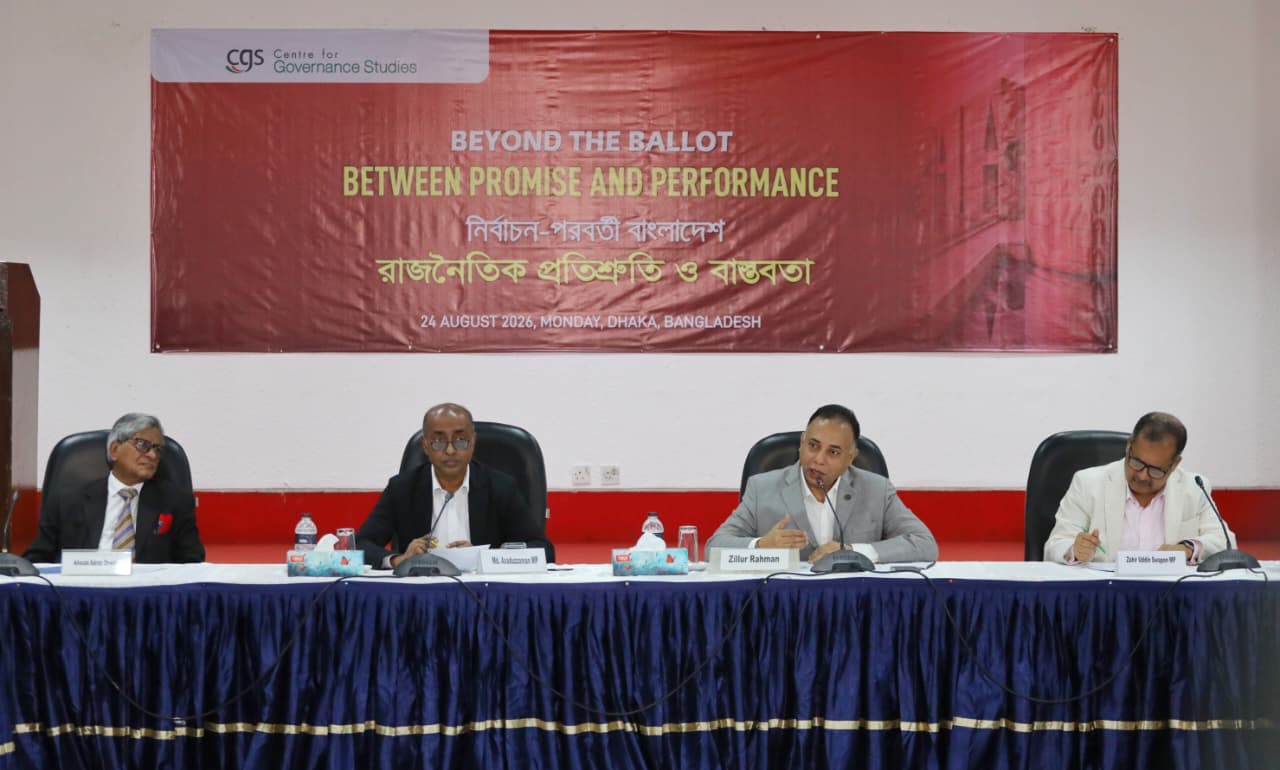
The Centre for Governance Studies (CGS) organized a national-level multi-party dialogue titled “Beyond the Ballot: Between Promise and Performance” on Monday, 24 August 2026, at the CIRDAP Auditorium in Dhaka. The dialogue was organized under the CGS initiative “Beyond the Ballot: Strengthening Transparency and Inclusion in Bangladesh’s Democratic Process,” supported by the National Endowment for Democracy (NED).
The dialogue examined how effectively political commitments made during the February 2026 parliamentary election were being translated into concrete actions following the formation of the new government. The discussion was based on the findings of the Pledge Tracker Mid-Term Assessment Report, which monitored the progress of political commitments made by both the ruling party and opposition parties during the first six months after the election.
The Pledge Tracker assessed 218 political commitments across eight thematic areas, including 116 commitments made by the ruling party and 102 commitments made by opposition parties. The assessment focused on verifiable actions, including legislation, policy decisions, institutional reforms, public programmes, parliamentary engagement, and political advocacy rather than political statements or intentions.
The dialogue brought together representatives from political parties, government, legal professionals, journalists, human rights activists, civil society representatives, and academics to discuss the gap between electoral promises and actual performance. The discussion focused on political accountability, institutional reform, governance challenges, democratic oversight, and the importance of transparent monitoring of political commitments.
The event began with a presentation of the Pledge Tracker Mid-Term Assessment Report by the CGS research team. The presentation highlighted the methodology of the tracker, the monitoring framework, the assessment process, and key findings from six months of monitoring government and opposition commitments.
The assessment identified progress in several areas, including electoral reform, economic and financial governance, agricultural support, social protection, judicial services, and programmes focused on women’s development. However, it also found that many commitments remained at the planning, legislative, preparatory, or pilot stages, raising concerns regarding implementation capacity, institutional independence, financial sustainability, transparency, and long-term impact.
The discussion provided a platform for political representatives and stakeholders to respond to the findings of the assessment and share perspectives on the challenges of implementing electoral commitments. At the beginning of the dialogue, Zillur Rahman, President of the Centre for Governance Studies (CGS), stated that citizens voted based on the commitments presented by political parties in their election manifestos. He emphasized that although the government faces various challenges, public expectations were created through those commitments, and political actors must take responsibility for ensuring their implementation.
Mohammad Asaduzzaman MP, Minister for Law, Justice and Parliamentary Affairs, emphasized the importance of constructive public scrutiny and accountability. He stated that political pressure is necessary but should be exercised through appropriate methods. He highlighted ongoing efforts toward institutional and political reform, including addressing allegations of enforced disappearances, strengthening accountability mechanisms, and changing political culture. He acknowledged that reforms require time and stated that the government remains open to correction where necessary. He also emphasized that constitutional reforms should move forward through reasonable proposals and reiterated the importance of moving away from a culture of disappearances and establishing accountability.
Zahir Uddin Swapan MP, Political Adviser to the Prime Minister, stated that the July movement should be understood as a movement for reform rather than a revolution. He emphasized that political consensus among stakeholders is essential for advancing reforms and argued that all political actors must be constructively engaged in the process. He highlighted the importance of reducing political divisions through regular communication and ensuring that national interests remain central in policy decisions, particularly in foreign policy.
Barrister Shamim Haider Patwary, Secretary General of Jatiya Party, emphasized that reforms cannot succeed without strengthening national unity and identity. He called for broader national dialogue on issues including judicial appointments, judicial processes, and foreign policy while keeping national interests at the center.
Faridul Haque, Joint Member Secretary of National Citizen Party (NCP), raised concerns regarding institutional reform and argued that changing names or structures alone would not address deeper systemic problems. He stressed the need for fundamental changes in political culture.
Monira Sharmin, Joint Convener of National Citizen Party (NCP), emphasized the importance of maintaining public trust in political actors. She stated that confidence among citizens should not be lost and highlighted the importance of respecting public mandates.
Dr. Mushtaq Hossain, Presidium Member of Bangladesh Jatiya Samajtantrik Dal (JASAD), highlighted challenges in the health sector and argued that focusing only on individual professionals does not address broader structural problems. He called for greater attention to institutional reforms within healthcare.
Dr. Ahmad Abdul Kader, Secretary General of Khelafat Majlis, stated that the purpose of governance should extend beyond a single electoral term. He emphasized the importance of respecting public mandates and ensuring that reforms prevent the return of authoritarian practices.
Subrata Chowdhury, President of Gono Forum, stated that citizens are now more aware and capable of evaluating government performance. He emphasized the need for practical approaches based on reality and collective efforts to address national challenges.
Barrister Mohammad Ali, Bangladesh Supreme Court, raised concerns over continued mob violence and stated that such instability could negatively affect investment and public confidence. He emphasized the importance of restoring trust in the banking sector and strengthening institutional stability.
Sohrab Hassan, Senior Journalist and Editor, highlighted that fundamental elements required for building a humane state remain incomplete. He emphasized the need to remove barriers affecting media freedom and ensure an independent press environment.
Advocate M. Iqbal Hasan, Bangladesh Islami Front, raised concerns regarding attacks on religious and cultural sites and argued that stronger action is required against such incidents. He also emphasized the importance of police reform.
Sanjeeb Drong, General Secretary of Bangladesh Indigenous Peoples Forum, emphasized the need for a clear roadmap for implementing political commitments. He called for future commissions and institutions to be more inclusive of different communities living in Bangladesh.
Barrister Nasreen Sultana Mily, Joint General Secretary of AB Party, stressed that the rule of law must apply equally to all citizens. She emphasized the importance of restoring public confidence in human rights institutions and ensuring citizen security through concrete actions.
Joly Talukder, Presidium Member of Communist Party of Bangladesh (CPB), highlighted the importance of responsible statements and effective measures to maintain public confidence in law enforcement. She stated that citizens expect visible changes aligned with the aspirations of the July movement.
Mujibur Rahman Manju, Chairman of AB Party, emphasized that political parties often change their behavior after gaining power within existing structures. He called for cooperation between government and opposition parties to ensure a democratic environment.
Hasan Al Mamun, General Secretary of Gono Odhikar Parishad, acknowledged shortcomings of the current government but noted expectations regarding human rights protection and citizen security.
Didar Bhuiyan, Joint General Secretary of Rashtra Sanskar Andolon, discussed concerns regarding political space and emphasized the need for an inclusive process to build a new Bangladesh.
The discussion concluded with a shared recognition that political commitments require sustained attention, institutional capacity, and measurable implementation strategies. Participants emphasized that democratic accountability cannot end with elections and that continued monitoring, transparency, and constructive political dialogue are essential to ensure that electoral commitments translate into meaningful outcomes.
The dialogue reinforced the importance of evidence-based monitoring mechanisms such as the Pledge Tracker in strengthening public accountability and enabling citizens to evaluate the performance of political actors beyond election periods.
The findings of the Mid-Term Assessment were presented during the dialogue, while the full report “Beyond the Ballot: Between Promise and Performance” is being finalized for publication and wider dissemination.
Annex
List of Speakers
|
No. |
Name |
Designation |
|
1 |
Mohammad Asaduzzaman MP |
Minister for Law, Justice and Parliamentary Affairs |
|
2 |
Zahir Uddin Swapan MP |
Political Adviser to the Prime Minister |
|
3 |
Mujibur Rahman Manju |
Chairman, AB Party |
|
4 |
Barrister Shamim Haider Patwary |
Secretary General, Jatiya Party |
|
5 |
Subrata Chowdhury |
President, Gono Forum |
|
6 |
Faridul Haque |
Joint Member Secretary, National Citizen Party |
|
7 |
Monira Sharmin |
Joint Convener, National Citizen Party |
|
8 |
Dr. Mushtaq Hossain |
Presidium Member, Bangladesh Jatiya Samajtantrik Dal |
|
9 |
Dr. Ahmad Abdul Kader |
Secretary General, Khelafat Majlis |
|
10 |
Didar Bhuiyan |
Joint General Secretary, Rashtra Sanskar Andolon |
|
11 |
Barrister Mohammad Ali |
Bangladesh Supreme Court |
|
12 |
Sohrab Hassan |
Senior Journalist and Editor |
|
13 |
Hasan Al Mamun |
General Secretary, Gono Odhikar Parishad |
|
14 |
Advocate M. Iqbal Hasan |
Bangladesh Islami Front |
|
15 |
Sanjeeb Drong |
General Secretary, Bangladesh Indigenous Peoples Forum |
|
16 |
Barrister Nasreen Sultana Mily |
Joint General Secretary, AB Party |
|
17 |
Joly Talukder |
Presidium Member, Communist Party of Bangladesh |
|
18 |
Zillur Rahman |
President, Centre for Governance Studies |