From Pledges to Practice: Political Inclusion & Democratic Accountability– Bangladesh’s Polls 2026
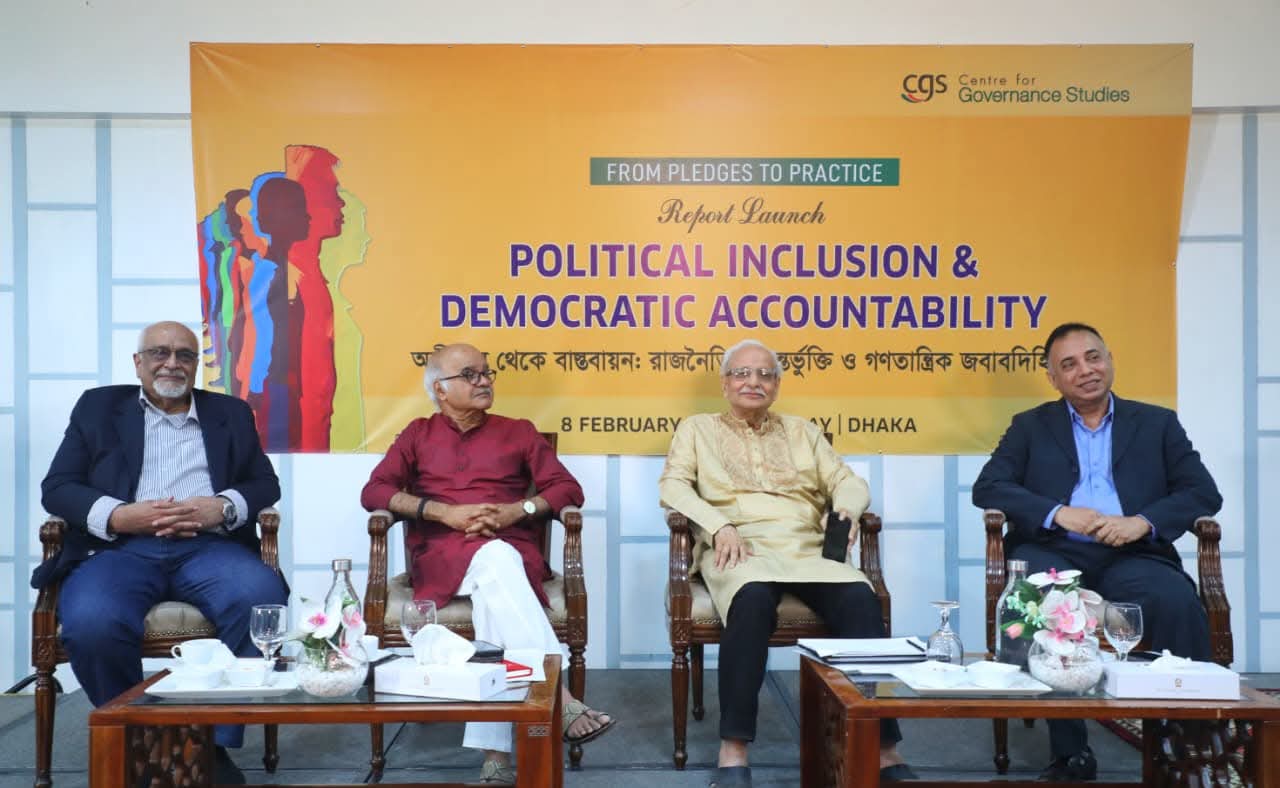
The Center for Governance Studies (CGS) organized a report launch event titled “From Pledges to Practice: Political Inclusion & Democratic Accountability– Bangladesh’s Polls 2026.” The event was held on Sunday, February 8, 2026, at 10:00 AM at the Hotel Pan Pacific Sonargaon (Padma Hall) in Dhaka. During the event, research findings and recommendations were presented on ensuring an inclusive, safe, and reliable election for minority and marginalized communities as Bangladesh approaches the 13th National Parliamentary Election. The discussion highlighted the electoral realities and obstacles faced by religious minorities, ethnic groups, and gender-diverse populations, as well as the implementation of constitutional pledges regarding equality and non-discrimination.
At the outset of the event, Zillur Rahman (President, Center for Governance Studies – CGS) emphasized that although the research was undertaken with the forthcoming national election in view, its relevance extends well beyond a single electoral cycle. He noted that the report captures a deeper and long-standing democratic crisis rooted in structural inequality. Recalling the central pledge of the 1971 Liberation War to establish an egalitarian society, he observed that more than five decades after independence, this promise remains unfulfilled. According to him, the 2024 mass uprising was fundamentally a response to entrenched inequality, which continues to persist across Bangladesh—between men and women, across religions and identities, and between the center and the periphery.
He pointed out that while the Constitution avoids the explicit use of the term “minority,” many communities continue to experience political and social marginalization in practice. He further noted that misinformation, rumors, and cross-border disinformation have exacerbated these vulnerabilities. While the rule of law is often presented as a universal solution, recent experience, he argued, has shown how legal norms are frequently undermined and displaced by mob pressure. Drawing attention to representation gaps, he highlighted that despite women comprising nearly 51 percent of the population, political parties have nominated very few women candidates for the upcoming election. As an example, he noted that despite strong rhetoric on women’s empowerment, the BNP nominated only ten women candidates.
He further observed that although democratic transition is widely discussed, its implementation remains uncertain. The research indicates that political parties often release ambitious election manifestos but fail to ensure follow-through once elections conclude. He also noted the demographic decline of Hindu, Buddhist, and Christian populations since 1971, despite their relatively larger presence before 1947. Against this backdrop, CGS conducted a comprehensive study covering hill Indigenous peoples, plains Indigenous peoples, religious minorities, socio-economically marginalized communities, and transgender communities.
The study included a survey of 505 respondents—115 from Chittagong Hill Tracts Indigenous communities, 125 from plains Indigenous communities, 165 from religious minorities, and 100 from socio-economically marginalized groups. In addition, ten key informant interviews were conducted with representatives of civil society, journalists, and minority communities, alongside four regional roundtable discussions held in Dhaka, Sylhet, and Rangpur. The findings show that while most respondents are aware of their voting rights, many lack information on where and how to report electoral irregularities or violence. A significant proportion reported feeling anxious and unsafe during elections. Fear of retaliation often leads to self-censorship and reduced political engagement. Insights from interviews and roundtables reveal deep distrust toward state and political institutions, with minority communities frequently excluded from democratic reform processes and treated primarily as vote banks within party structures. He concluded that sustainable democracy cannot be achieved by excluding any segment of society, stressing that inclusive elections, security, justice, and representation are fundamental state responsibilities.
BadiulAlam Majumdar, Secretary, SHUJAN stated that there has been no meaningful improvement in the conditions of marginalized communities, including women and minorities, over the years. Despite repeated reform proposals, most electoral reforms remain unimplemented in practice, raising serious doubts about whether the upcoming election will be free, fair, and inclusive. He observed that public trust in the electoral system has steadily eroded. He further noted that when political parties come to power, wealth and influence often become concentrated among affiliated individuals, fostering a patronage-based culture of impunity that undermines democratic accountability.
He emphasized that electoral malpractice continues to be a major concern, citing persistent allegations of vote-buying, coercion, and manipulation. Questions also remain regarding the effectiveness, neutrality, and independence of election management bodies. Deficiencies in oversight and enforcement have generated widespread skepticism about electoral administration. Despite these challenges, he noted that there remains a strong public aspiration for credible elections. Restoring electoral integrity, he argued, is essential not only to rebuild trust but also to ensure that democratic participation is meaningful and inclusive. Addressing these challenges requires political will, institutional reform, and accountability in both law and practice.
DebapriyaBhatttacharya, distinguished fellow at Center for Policy Dialogue (CPD) expressed agreement with the data and analysis presented in the CGS report and endorsed its core findings. He identified justice, reform, and elections as the government’s three primary priorities, with security as a critical fourth. According to him, the most significant shift has been in public expectations, as long marginalized communities are now increasingly visible and vocal in the public sphere. He attributed this change to the role of ordinary citizens, the media, and civil society.
He observed that while political parties could have presented more progressive and inclusive manifestos, the existing commitments should not be dismissed outright. However, he stressed that without accountability, even the most comprehensive manifestos lose significance. He noted that Bangladesh remains capable of holding participatory elections, but those resistant to such processes often do not perceive voting as socially beneficial. Without ensuring the safety of marginalized communities before and after elections, he warned, democratic processes will remain fragile. He further stated that if the interim government succeeds in delivering a credible election, it will represent a historic achievement. He expressed concern over the continued decline in minority representation and noted that minority representatives in past parliaments were often unable to raise minority concerns effectively. He emphasized that minority issues must be treated as national issues and warned that neglecting these concerns could lead to broader national security challenges.
Finally, Selim Jahan (Economist) noted that while the Constitution guarantees equal rights and envisions inclusive elections, recurring questions about inclusiveness point out deep institutional failure. In practice, constitutional commitments have been repeatedly violated, and minority security and political rights have not been adequately protected. He observed that limited access to education and political awareness heightens vulnerability within minority communities, particularly during elections. Rural women voters face additional barriers in patriarchal social structures where voting decisions are often influenced by male family members or local power holders.
He further noted that fear and insecurity intensify these constraints, with elections often perceived by marginalized communities as periods of heightened risk rather than civic participation. Despite the presence of multiple political parties, women and minorities remain significantly underrepresented, and symbolic inclusion frequently substitutes for genuine empowerment. He concluded that the persistent gap between constitutional promises and lived electoral realities continues to undermine inclusiveness, credibility, and democratic integrity.
List of Speakers
|
Serial No. |
Name |
Designation |
|
1 |
Debapriya Bhattacharya |
Distinguished Fellow, CPD |
|
2 |
Selim Jahan |
Economist |
|
3 |
BadiulAlam Majumdar |
Secretary, SHUJAN |
|
4 |
Zillur Rahman |
President, Center for Governance Studies (CGS) |