An Inclusive Election: Minority Rights, Representation, and Democratic Credibility
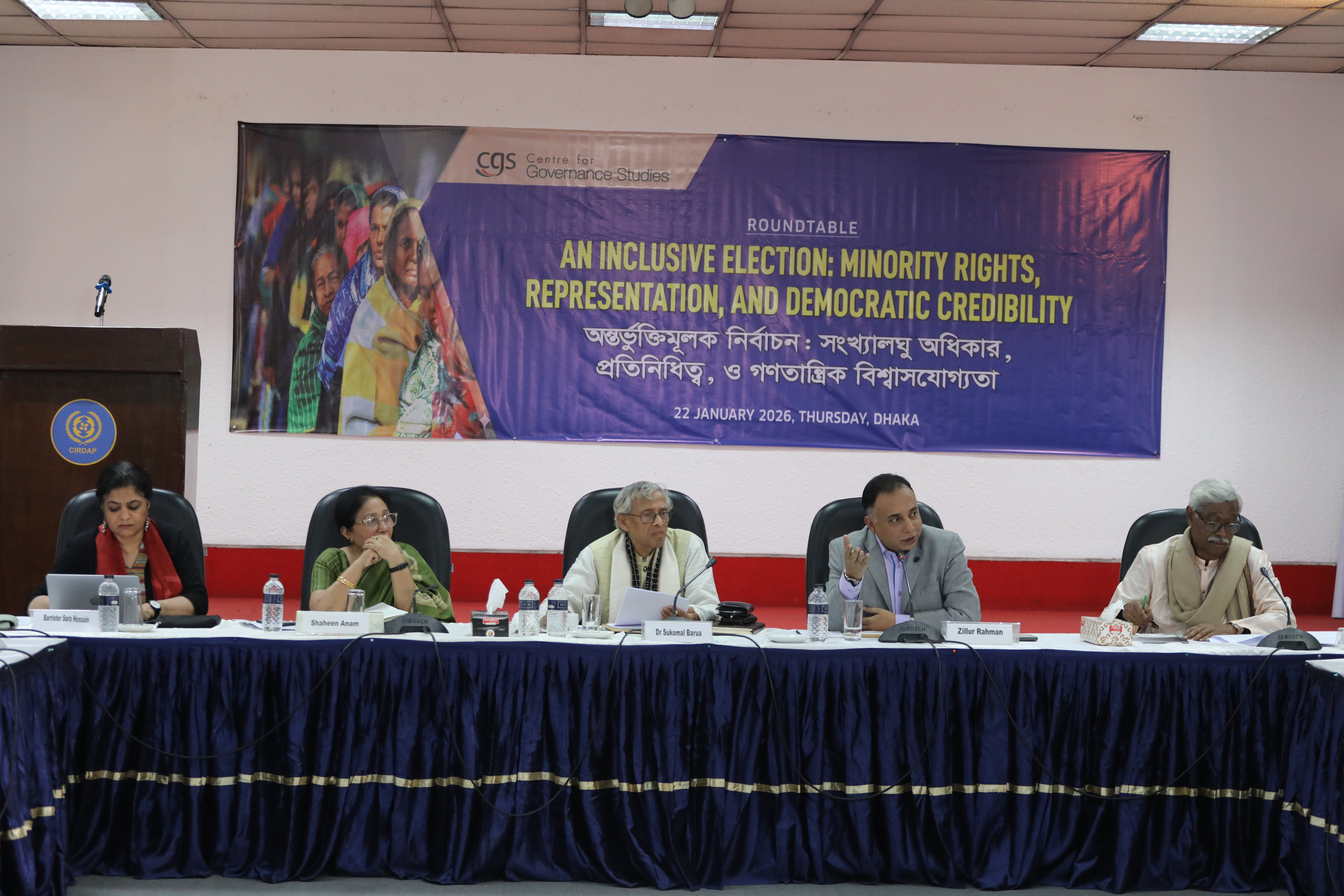
The Centre for Governance Studies (CGS) organized a roundtable titled “An Inclusive Election: Minority Rights, Representation, and Democratic Credibility” on Thursday, January 22, 2026, at 3:00 PM at the CIRDAP Auditorium in Dhaka. The dialogue brought together political leaders, representatives of minority communities, human rights activists, lawyers, academics, journalists, civil society members, and election experts to discuss minority rights, representation, security, and democratic credibility ahead of the upcoming national election.
The discussion took place at a time when concerns over voting rights, political participation, communal security, legal protection, and meaningful representation of minority and marginalized communities remain deeply connected to the broader question of democracy and rule of law in Bangladesh. Speakers emphasized that an inclusive election cannot be ensured only through voting arrangements. It must also guarantee safety, equal citizenship, freedom from intimidation, access to justice, and the confidence of all communities in the democratic process.
At the beginning of the dialogue, Zillur Rahman, President of the Centre for Governance Studies (CGS), stated that although Bangladesh has held many elections, questions remain over whether those elections were truly fair and inclusive. He noted that after the July movement, people had hoped for a better and more inclusive election, but many minority and marginalized groups still feel excluded and insecure. He emphasized that religious minorities and indigenous communities must be considered within the wider democratic framework, as their rights are directly connected to the rule of law and the character of the state. Rahman said that many minorities outside Dhaka do not feel safe and are uncertain about whether they can vote freely. He further stated that the crisis facing minorities is not separate from the crisis of democracy itself. He stressed that the state must identify where attacks and intimidation are taking place and take effective steps to protect vulnerable communities. He concluded by calling for unity, stronger public voices, and greater accountability to ensure justice and equal rights.
ShaheenAnam, Executive Director of ManusherJonno Foundation, said that the trust of minorities in the state and justice system has been seriously damaged. She noted that attacks on homes, property, and the lives of minority communities have often taken place without transparent justice processes. As a result, victims no longer believe that justice will be ensured. She stated that minority persecution is rooted in weaknesses within social, political, and legal systems, and unless these structural issues are addressed, the problem will continue. She emphasized the need to build social harmony, accept differences of opinion, and restore confidence among minority communities. She also called for the implementation of the Witness Victim Protection Act and stressed the importance of ensuring the independence of the National Human Rights Commission.
Advocate Sara Hossain observed that minority issues should be understood broadly, as there are vulnerable groups within different communities, including within the Muslim population. She pointed out that women from conservative backgrounds, children, and communities in different parts of the country have faced various forms of insecurity and discrimination. She stated that with the election approaching, the Election Commission must pay close attention to incidents of violence and intimidation. She also emphasized the need for an effective and responsive hotline system, particularly for communities living in remote areas. She further noted that the situation in the hill regions should be closely monitored and that urgent action is needed to address false cases and prevent further complications before the end of the government’s term.
Professor Dr. Sukomal Barua said that Bangladesh has still not been able to resolve the identity crisis of indigenous and minority communities. He noted that even after more than five decades of independence, indigenous peoples have not received proper recognition. He emphasized that minority communities must come together through a rights-based coalition to build trust and strengthen their collective voice. He argued that minorities should not be treated merely as vote banks by political parties. Instead, political parties must clearly state how they will protect minority rights and ensure representation. He said that voting decisions should be based on whether parties make credible commitments to the rights and security of minorities.
Advocate Subrata Chowdhury, Member of the Presidium of the Bangladesh Hindu Buddhist Christian Unity Council, stated that promises made to minority communities have repeatedly remained unfulfilled throughout Bangladesh’s history. He said that oppression and discrimination have continued under different governments, yet no lasting solution has been achieved. He expressed concern over the current environment and said that people had expected democracy but were facing a situation of fear and mob pressure. He noted that there is still hope surrounding the upcoming election, but whether that hope will be realized depends on the commitment of the government, judiciary, and political actors to establish justice.
Jayanta Kumar Deb, President of Dhaka MohanagarSarbojanin Puja Committee, said that the state often reminds people of their minority identity, which contributes to continuous discrimination and vulnerability. He stated that in such a reality, imagining a truly inclusive election becomes difficult. Minorities are deprived not only of representation but also of meaningful participation in democratic processes. He emphasized that if people are given the opportunity to speak freely, an inclusive election may become possible. He added that standing beside the weak and marginalized is essential because real progress can only be achieved when their voices are heard and respected.
Bijan Kanti Sarkar, Chairman of the Hindu-Buddhist-Christian Welfare Front, said that although Bangladesh’s constitution contains important provisions, many of them are not properly enforced. He noted that legal protection and accountability remain weak, which undermines justice and equality. Referring to recent incidents of violence and intolerance, he said that such developments show the urgent need to protect democratic values and ensure accountability for all forms of communal and political violence.
Manindra Kumar Nath, Acting General Secretary of the Bangladesh Hindu Buddhist Christian Unity Council, said that many promises have been made about building an inclusive society, but implementation remains weak. He observed that the demand for reserved seats for minorities in Parliament has been discussed, but institutional barriers remain across government and executive structures. He argued that the absence of sincere and practical steps has continued to deprive minority communities and has weakened the possibility of building a truly inclusive society.
Basudev Dhar, President of Bangladesh Puja Udjapan Parishad, stated that minority communities speak about equal rights because they continue to face discrimination and insecurity. He said that the elections of 2014, 2018, and 2024 were not inclusive and expressed doubt about whether the 2026 election would be inclusive. He noted that many minority voters feel threatened and cannot freely decide whom to vote for. He also raised concerns over attacks on temples and the fear that minorities may not be able to vote safely in the upcoming election. He stressed that the state must ensure a secure voting environment for all citizens.
Nirmal Rozario, Senior Vice President of the Bangladesh Hindu Buddhist Christian Unity Council, said that minority communities had raised demands under previous governments, but those demands were not implemented. He stated that political parties must take responsibility for minority rights, raise these issues in Parliament, and work for their implementation. He emphasized that discussions, seminars, and workshops will not bring meaningful change unless political parties internalize these demands and act on them. He called for the creation of public opinion in support of inclusion and equal rights.
Saud Khan Sardar, a leader of the Bede community, said that the Bede community remains one of the most vulnerable and neglected groups in Bangladesh. He noted that around seven to eight lakh Bede people live in the country, yet they have not received proper recognition or support under the electoral system. He said that discrimination affects their daily lives, including their access to markets and social acceptance. He called for a healthy election environment where every citizen can vote freely and without proxy voting or intimidation. He also emphasized the need to end the politics of vengeance and ensure representation for marginalized communities.
Barrister RuhulQuddusKazal, Senior Advocate of the Bangladesh Supreme Court, stated that the concerns raised by minority communities are often heard but not implemented. He said that if previous promises had been fulfilled, such discussions would not still be necessary in 2026. He emphasized that constitutional rights must be ensured for every citizen, regardless of religion, ethnicity, or caste. He called on the Election Commission to take election-related violence seriously and ensure that all voters have security. He also stressed the need for a more responsive hotline system, close monitoring of the hill regions, and steps to resolve false cases.
Bhikkhu Sunanda Priyo said that the eight-point demands had been raised in the past and promises had been made repeatedly, but they were never implemented. He noted that discrimination against minorities continues and that many had hoped the interim government would bring positive change. However, he said that minorities remain deprived of justice. He asked where minorities should go if they cannot obtain justice in their own country.
Barrister Shihab Uddin Khan, Advocate of the Bangladesh Supreme Court, said that the frustration surrounding minority rights is closely linked to the unresolved question of self-identity. He noted that different minority communities are losing language, culture, and traditions due to continued neglect. He stated that the constitution speaks of equal rights for all citizens, but implementation remains weak. He called for a change in the mindset of political parties and urged the next elected government to take urgent steps for minority representation in Parliament. He also suggested that international conferences should be held to discuss minority rights more seriously.
Advocate Nicholas Chakma, Division Head of Dalit Parishad Dhaka, said that indigenous communities in the Chittagong Hill Tracts continue to suffer from an identity crisis. He noted that the Chittagong Hill Tracts Accord and the constitution refer to indigenous and ethnic minority communities, yet the crisis of recognition remains unresolved. He stated that there is currently no proper environment for minorities to participate in elections. He emphasized that without the participation of minorities in Parliament, their rights, suffering, and needs will remain poorly understood by the wider public.
Falguni Tripura, President of Bangladesh Adivasi Nari Network, said that Bangladesh lacks a strong political culture, which contributes to the spread of hate speech and social division. She noted that those who are not affiliated with political parties are often deprived of opportunities. She also raised concerns over land rights and the lack of protection for marginalized communities. She stated that without legal safeguards and political accountability, meaningful progress and justice will remain difficult to achieve.
Partha Shankar Saha, Assistant News Editor of Prothom Alo, said that the right to vote is no longer simply a personal choice for many people, as it has come under surveillance and control. He expressed concern over widespread denial and the lack of accountability, which continue to weaken public trust in the system. He emphasized the need for a separate hotline for minorities so that they can seek assistance during crises. He also called on political parties to clearly mention in their election manifestos how they will address the urgent issues facing minority communities.
Ho Chi Minh Islam, Founder and Executive Director of Krishnachura: Center for Gender Minorities Rights, said that the concerns of gender minorities are often ignored in political discussions. He noted that reform discussions often remain theoretical and are rarely implemented in practice. He emphasized that Hijra and Queer communities continue to remain invisible in mainstream political debate. He warned that when people remain silent about their rights, democracy itself becomes weaker and vulnerable groups become further marginalized.
Chandra Mohan Robidas said that discrimination is a daily reality for communities such as the Ravidash and Harijan communities. He noted that even after political changes, many marginalized groups continue to live in fear. He called for proper attention to the July Charter and said that threats and violence continue despite changes in government. He stressed that clear incidents of violence and discrimination must be addressed through meaningful government action.
The dialogue was moderated by Zillur Rahman, President of the Centre for Governance Studies (CGS). Speakers agreed that minority rights, voting security, political representation, and access to justice are essential for ensuring a credible and inclusive election. They emphasized that political parties, the Election Commission, the judiciary, and the state must take concrete steps to protect marginalized communities and restore public trust in the democratic process.
Annex
List of Speakers
|
Serial No. |
Name of Speaker |
Designation/Role |
|
1 |
Advocate Subrata Chowdhury |
Member, Presidium, Bangladesh Hindu Buddhist Christian Unity Council |
|
2 |
Bijan Kanti Sarkar |
Chairman, Hindu-Buddhist-Christian Welfare Front |
|
3 |
Falguni Tripura |
President, Bangladesh Adivasi Nari Network |
|
4 |
Partha Shankar Saha |
Assistant News Editor, Prothom Alo |
|
5 |
Ho Chi Minh Islam |
Founder and Executive Director, Krishnachura: Center for Gender Minorities Rights |
|
6 |
ShaheenAnam |
Executive Director, ManusherJonno Foundation |
|
7 |
Barrister RuhulQuddusKazal |
Senior Advocate, Bangladesh Supreme Court |
|
8 |
Advocate Sara Hossain |
Senior Advocate, Bangladesh Supreme Court |
|
9 |
Barrister Shihab Uddin Khan |
Advocate, Bangladesh Supreme Court |
|
10 |
Basudev Dhar |
President, Bangladesh Puja Udjapan Parishad |
|
11 |
Manindra Kumar Nath |
Acting General Secretary, Bangladesh Hindu Buddhist Christian Unity Council |
|
12 |
Advocate Nicholas Chakma |
Division Head, Dalit Parishad Dhaka |
|
13 |
Chandra Mohan Robidas |
Representative of marginalized community |
|
14 |
Bhikkhu Sunanda Priyo |
Religious leader |
|
15 |
Nirmal Rozario |
Senior Vice President, Bangladesh Hindu Buddhist Christian Unity Council |
|
16 |
Dr. Sukomal Barua |
Adviser to the BNP Chairperson |
|
17 |
Jayanta Kumar Deb |
President, Dhaka MohanagarSarbojanin Puja Committee |
|
18 |
Saud Khan Sardar |
Leader of Bede Community |
|
19 |
Zillur Rahman |
President, Centre for Governance Studies |
|
20 |
Parvez Karim Abbasi |
Executive Director, Centre for Governance Studies |